



Ulf Åkerström
CIO SKINOME

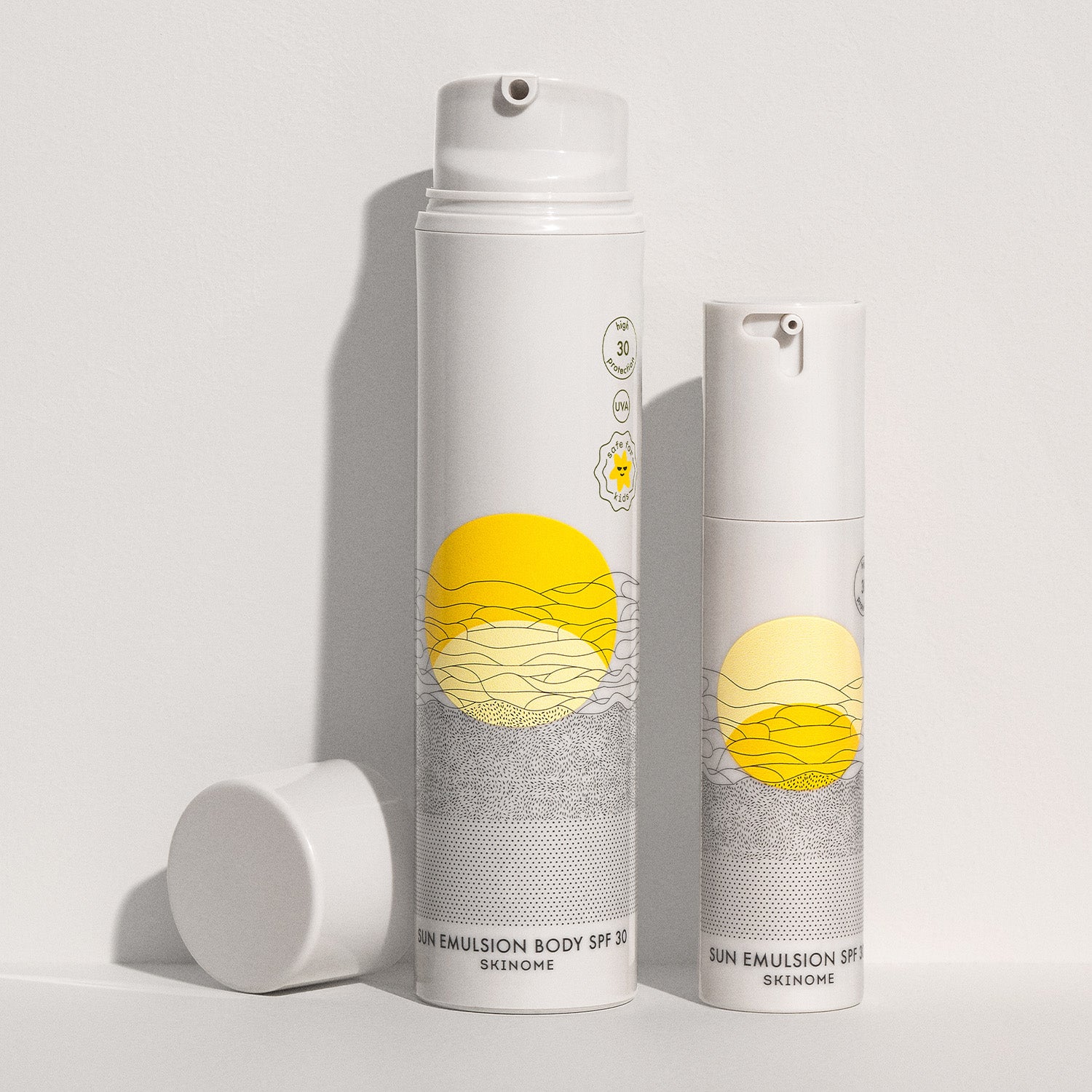
Value kit with Sun Emulsion SPF 30 for the face and Sun Emulsion Body SPF 30 for the body. Together they give you high protection against both UVA and UVB rays and do not contain perfume, suspected hormone-disrupting UV filters or other unnecessary additives and are therefore suitable for even the most sensitive skin. Dermatologically tested on atopic and sensitive skin. Store at room temperature.
Buy It With
149,00 NOK
Buy It With
269,00 NOK

Effective sun protection that protects against both UVA & UVB rays

Does not contain unnecessary additives or suspected hormone-disrupting ingredients

Developed and freshly made in Sweden


CIO SKINOME

Enhances the effect of UV filters and protects against air pollution.
Provides high protection against both UVA and UVB radiation.
Deeply moisturizes and soothes the skin.
Yes, the products only contain safe filters that are not tested for hormone disruption.
Yes, you really can. As the products are free from unnecessary additives and only contain safe and secure filters, our sunscreens are optimal for children.
Yes, our sunscreen is developed to be environmentally friendly and therefore does not contain any organic UV filters that are known to, or suspected of, affecting aquatic organisms. They also do not contain any of the organic UV filters suspected of being harmful to corals and are therefore “reef safe”.
Our sunscreens contain both titanium dioxide and zinc oxide, the latter of which is particularly associated with environmentally problematic properties. Zinc is a substance that occurs naturally in the environment and is essential for all cells and organisms to function normally. Therefore, only higher levels of zinc can be toxic. Our sunscreen contains a small amount of zinc, which provides a limited spread and addition of zinc to the environment.
Overall, we have assessed that the low amount has a very small impact on the natural amount already present in our environment, and that the positive benefits of zinc oxide in sunscreen products outweigh the risks of its use, and that our product does not pose an environmental problem.
If you are only outside for short periods in the morning and evening when the UV index is below 2, you usually don't need sun protection. However, always have sun protection available in case you spend more time outdoors than planned.
We recommend using fresh products that have not passed their expiration date to ensure the best protection.
In general, we recommend sun protection when the UV index is above 2.
No, our sunscreens should be stored at room temperature and are fine to bring on sunny days at the beach.
The choice between SPF 30 and SPF 50+ depends on several factors, including skin type, sun intensity, and how long you will be outdoors.
Choose SPF 50+ if:
Choose SPF 30 if:
Our sunscreens contain a combination of modern organic (chemical) filters and physical (mineral) filters, to provide broad and effective protection against both UVA and UVB radiation.
Organic filters are soluble (with a few exceptions) substances consisting of carbon-based compounds. They protect the skin by absorbing UV radiation and converting it into harmless energy.
Physical filters consist of small, insoluble particles – primarily zinc oxide and titanium dioxide. They protect the skin by scattering, reflecting, and to some extent also absorbing UV radiation.
The difference between the filter types thus lies in their structure, solubility, and how they interact with UV light. By combining both types, we can optimize protection, stability, and feel on the skin.
Zinc oxide and titanium dioxide are the two approved mineral filters that are often combined to provide optimal UV protection. Together, zinc oxide and titanium dioxide provide very good protection against both UVB and UVA, and also protect against longer UVA wavelengths (340 to 400 nm).
Both zinc and titanium dioxide are very photostable and do not react with other UV filters. Smaller particles, so-called nanoparticles, also provide better protection against the sun's UV rays than larger particles.
Another advantage of the smaller nanoparticles is that they reduce the white residue that mineral filters can leave on the skin. The smaller the particles, the less of a white layer the filter leaves on the skin.
Even though nanoparticles are small, they are still too large to penetrate the skin, and much larger than most other substances and UV filters used.
There is an identified risk if the particles are inhaled, and therefore they are not used in spray products, but in creams they are completely safe.
For the face and neck, approximately one teaspoon of sunscreen is needed. For the entire body, about a handful is required. Apply generously to achieve the SPF stated on the packaging and reapply as needed.
Even though the skin becomes somewhat more resilient, it doesn't protect against damage from UV radiation.
